

MASTER OF DESIGN
Designed for students and professionals from diverse backgrounds, M.Des is a UGC-approved degree programme offered by the top-ranked O.P. Jindal Global University at The Design Village’s India campus. The two-year postgraduate programme is taught with a deep focus on industry-relevant expertise to prepare advanced professionals who can work as creative leaders.
Students are taken through an award-winning curriculum as recognized by the Don Norman Design Award, work on multiple real-world projects introduced by leading companies, and undertake two capstone projects, together culminating into a creative portfolio.
M.Des programme encompasses a professional development module that covers advanced communication, leadership skills, in-demand software training, and portfolio building blocks.
Format
Degree awarded by
Classes begin
Eligibility
Duration
Course Fee

(HIGHLIGHTS)
WHY Study at
the Design Village

INSTITUTION BY THE INDUSTRY
Design School founded by prominent designers from India and Europe, with an intent to offer world’s best design education to Indian students: every decision at TDV, including curriculum, culture, partnerships etc. is shaped through a designer’s lens

CREDIBILITY AND RECOGNITION
Degree conferred by OP Jindal Global University (JGU), recognized as one of the twelve Institutions of Eminence (IoE) by Government of India, along with select IITs, BITS etc., and ranked #1 Private University in India by QS rankings for 3 years in a row

LOCATIONAL ADVANTAGE
TDV is located in the urban core of NCR, in a neighbourhood buzzing with artisans and craftspeople, allowing students to step straight into the world of design, fashion and media, through self-paced freelancing, internship and networking opportunities
POSTGRADUATE PROFESSIONAL MODULE
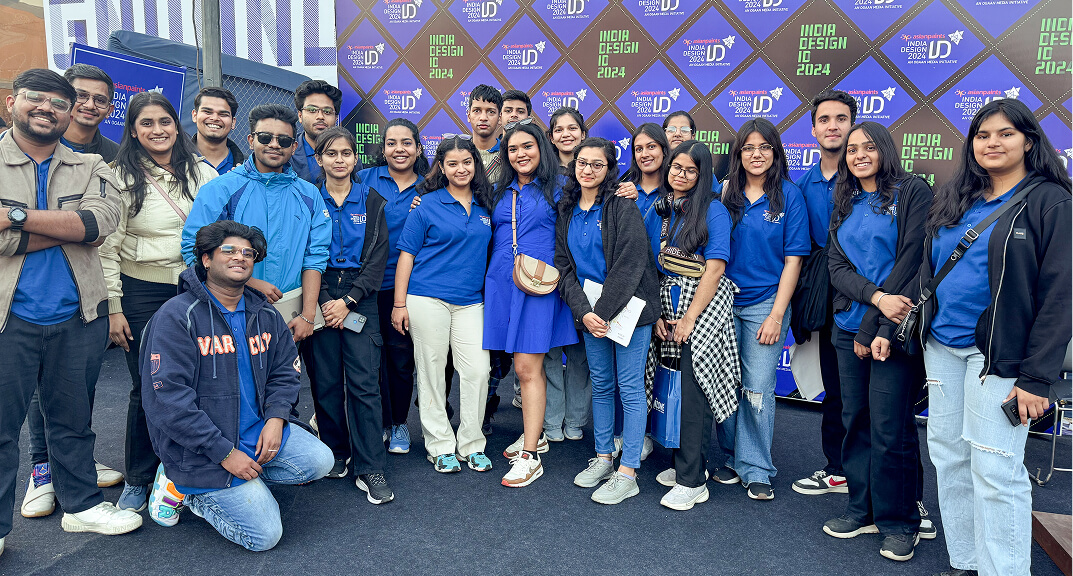
Secure your career prospects by preparing for market entry through TDV’s flagship Professional Development Module that focusses on your personality, creative portfolio, software skillset and a deep understanding of the profession
(EDUCATION)
SPECIALISATIONS
Career Pathways
Career Pathways
Career Pathways

Career Pathways

Career Pathways

Career Pathways
(CURRICULUM)
Industry-centric Curriculum
- SEM 01
- SEM 02
- SEM 03
- SEM 04
CODE
CREDITS
Course Title
MDF101
6
The discovery of the self in terms of ones ideology, attitude, skill set, temperament etc. need to be aligned to the awareness of the world around so that a designer is able to position themself in this world. The course entails understanding the mechanisms towards this, and helps bring students from different backgrounds together.
MDF102
4
Design thinking begins with material literacy. This course establishes the foundational understanding that materials are not passive recipients of form but active participants in meaning-making. Students learn to read materials for their expressive potential, structural logic, and cultural significance, developing the intelligence to choose and work with materials as intentional design decisions rather than default options.
Communication & Interaction: Materials, Medium and Interfaces
Fashion & Textile: Surfaces and Textiles
Interior & Space: Poetics of Space
Product & Industrial: Material, Form and Manufacturing
Strategic Design & Management: Consumer Behaviour
Transdisciplinary Design: Choose from 40+ options across all silos
MDF103
4
Design communication extends beyond the object itself. This course develops the capacity to translate complex ideas into clear visual and analytical narratives. Students learn that representation is not merely documentation but an act of interpretation and persuasion, building fluency in the languages needed to share their work, defend their decisions, and understand the contexts in which design operates.
Communication & Interaction: Representation & Prototyping
Fashion & Textile: Fashion Illustration
Interior & Space: Light, Volume & Surfaces
Product & Industrial: Rapid Prototyping and Representation
Strategic Design & Management: Brand and Marketing
Transdisciplinary Design: Choose from 40+ options across all silos
MDF104
4
Mastery requires understanding how to prototype and test ideas iteratively. This course develops the capacity to rapidly externalize thinking, whether through video, physical models, fabric structures, or spatial mock-ups. Students learn that prototyping is not about perfection but about making ideas tangible enough to critique, refine, and evolve, building confidence in working through uncertainty toward resolution.
Communication & Interaction: Interactive Design & Creative Coding
Fashion & Textile: Weaving and Textile Construction
Interior & Space: Furniture Design ad Materiality
Product & Industrial: Form Design and Ergonomics
Strategic Design & Management: Finance
Transdisciplinary Design: Choose from 40+ options across all silos
MDF105
4
Design realization demands structural and systematic thinking. This course cultivates the ability to move from idea to execution with technical confidence, understanding that form, construction, and production are not constraints but integral to design intention. Students learn to think through making, recognizing that how something is built fundamentally shapes what it communicates and how it performs.
Communication & Interaction: Animation & Game Design
Fashion & Textile: Garment Construction
Interior & Space: Structure Design
Product & Industrial: Product Packaging
Strategic Design & Management: Product Management
Transdisciplinary Design: Choose from 40+ options across all silos
MDF106
4
The course introduces students to what is commonly identified as the ‘design process’, the various stages involved in the creative endeavour, and the relevance of these sequentially-placed stages.
MDF107
4
CODE
CREDITS
Course Title
MDF201
2
Experiential learning module to nudge students to let go of all pre-conceived ideas and notions.
MDF202
2
The Design Village was honoured with the Don Norman Design Award for Recognition at the inaugural award ceremony for its innovative design curriculum and progressive pedagogical framework.
MDF203
2
The course aims to encourage designers to establish connections, and see the broader perspective of the space and interior design industry. As a part of this course, students study ‘systems’ in terms of society, politics, practices etc. that prevail in this sector.
MDF204
2
In this course, students are taught to analyse ‘why’ should a design exist, ‘what’ makes it better, and ‘how’ is it effective and efficient, helping them understand what makes for an impactful, timeless design.
MDF205
2
This course helps students understand the needs and motivation of the users, and are skilled to observe and interview stakeholders, collect artefacts, and gather necessary knowledge to map context.
MDF206
2
Project-based course to introduce students to systems thinking and giga-mapping of space and interior design through an open-ended, process driven, research lead project brief.
MDF207
2
Project-based course focussed on concept iterations and idea development through intense making and rapid prototyping, helping students learn to translate their space and interior design concepts from paper to tangible, material form.
CODE
CREDITS
Course Title
MDF101
3
A manifesto is the personal vision of every postgraduate student pursuing education at TDV. In this course, students explore the industry’s diversity and depth, with a goal to find their own position to contribute and identify their ‘niche’ space and interior design career direction.
MDF102
3
Aesthetics are core to every design project. The course inculcates an understanding of aesthetics that goes beyond surface-level visual appeal to experiences, multi-sensoriality and conceptual theories. It helps the student realize that aesthetics is not just about beauty, but also about the basic response to any and all objects of desire.
MDF103
3
Exchange of monetary values brings legal frameworks into the picture, and the designing of a business helps to understand that better. The course helps students becomes aware about the hurdles that may come in way of the intended design solution the designer has prepared for a user. Be it through entrepreneurship, partnership, or freelance, the designer is able to understand the costs and values of the markets, products and all other processes involved.
MDF104
3
Designers require skills to articulate the outcomes of their research, while being mindful that their personal briefs do not cloud their judgement. As a foundation to the dissertation, the colloquium teaches students critical analysis of information, identification of underlying assumptions, and constructing a persuasive argument for a space and interior design research.
MDF105
3
Project-based course that helps students understand critical enquiries, analytics and strategies to articulate a space and interior design intervention from a macro point-of-view.
CODE
CREDITS
Course Title
MDF401
6
As the last instructional module of the postgraduate programme, this course helps students kickstart their professional journey and ensure its tracking.
MDF402
24
Research-driven dissertation allows students to showcase the design thinking and research skills they have developed throughout the course. Students explore a topic of their interest, contributing to the field of space and interior design, while making a meaningful contribution to the industry.