


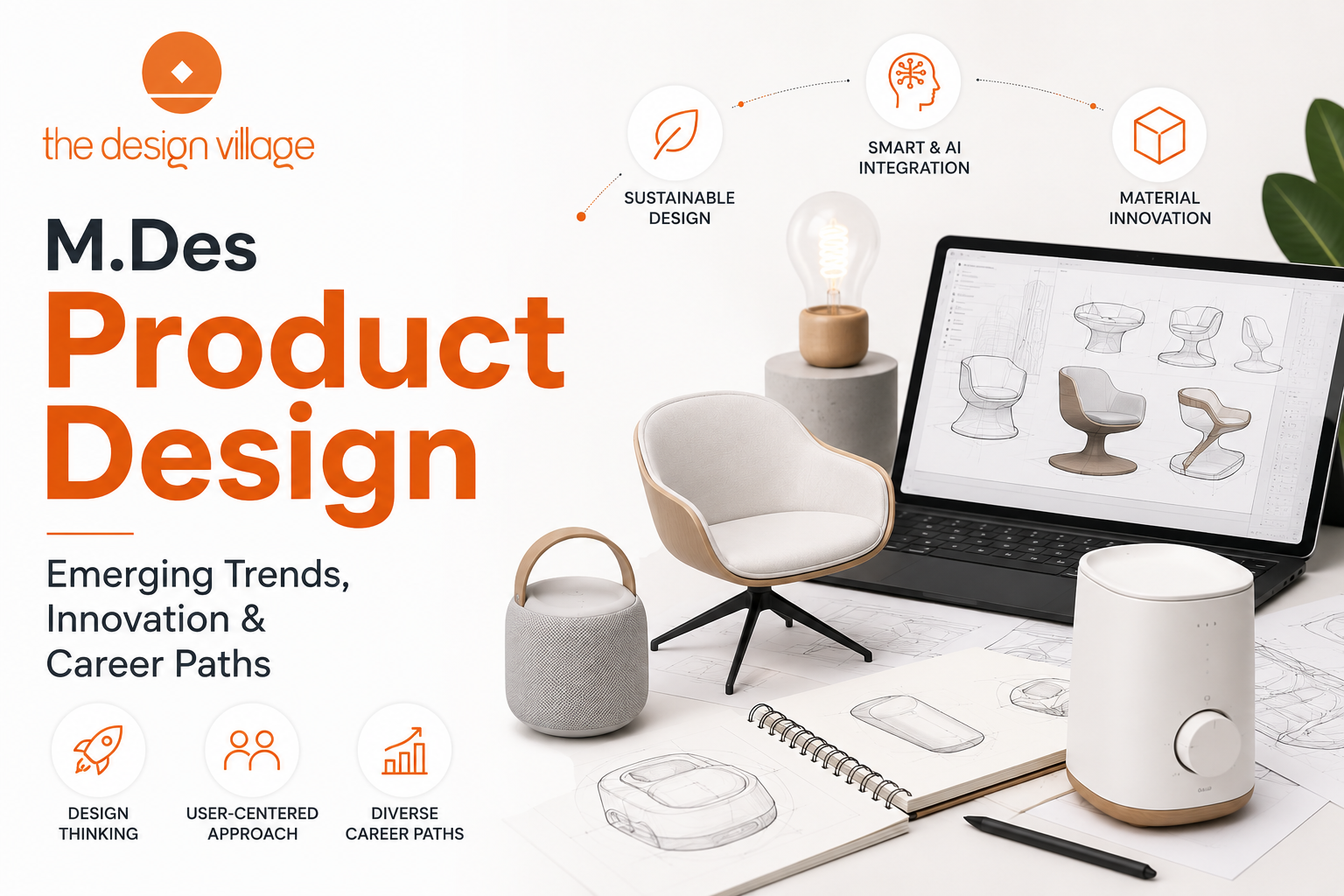
Behind every product that simplifies everyday life, whether it’s a smartphone, a vehicle, or the packaging of your favourite brand, is a product designer who understands people and transforms ideas into meaningful experiences.
As industries become increasingly user-centric and technology-driven, the demand for skilled product designers continues to grow. This has made an MDes in Product Design one of the most sought-after postgraduate programmes for students interested in creativity, innovation, research, and problem-solving.
Today, product design extends far beyond physical products. It intersects with AI, digital experiences, sustainability, healthcare innovation, advanced manufacturing, and emerging technologies.
For students considering a master’s in design, understanding current industry trends and career opportunities can help them make a more informed career choice.
Designing the Future: What an M.Des in Product Design Really Is?
An MDes in Product Design focuses on creating products, systems, and experiences that improve people’s lives.
The program helps students develop expertise in:
- User-focused design
- Design research
- Product innovation
- Design ideation
- Prototyping and testing
- Materials and manufacturing processes
- Sustainability and circular design
- Emerging technologies
Conventional design education focuses mainly on aesthetics, while modern product design emphasizes solving everyday problems through research, creativity, and innovation.
Why Product Design Is More Relevant Than Ever?
In a rapidly changing world, consumers expect products that are:
- Functional
- Sustainable
- Accessible
- User-friendly
- Technology-enabled
- Environmentally responsible
Companies are recognizing that great products create better customer experiences and strong business impact, which makes them invest excessively in design.
From startups to MNCs, organisations heavily rely on product designers to identify opportunities, make it convenient for users and develop innovative solutions.
This growing demand has significantly increased the value of pursuing a specialized M.Des course in Product Design.
Emerging Product Design Trends
1. Sustainable and Circular Design
Sustainability is no longer optional.
Designers are expected to create products that:
- Reduce waste
- Use eco-friendly materials
- Support recycling
- Extend product life cycles
Product designers help achieve environmental goals while maintaining functionality and profitability.
2. AI-Assisted Product Design
Artificial Intelligence is transforming the product design process by:
- Generating concepts faster
- Analyzing user behavior
- Optimizing product performance
- Improving prototyping efficiency
However, creativity, empathy, and user-centered thinking remain uniquely human strengths that technology cannot replace.
3. Smart Products and Connected Devices
The Internet of Things (IoT) continues to expand across industries.
Product designers increasingly work on:
- Smart home devices
- Wearable technology
- Healthcare products
- Connected appliances
- Industrial automation systems
Understanding both physical and digital interactions has become a valuable skill for modern product designers.
4. Inclusive and Accessible Design
Design today focuses on serving diverse user groups.
Organizations are prioritizing products that accommodate:
- Different age groups
- Cultural backgrounds
- Physical abilities
- Accessibility requirements
Inclusive design helps create better experiences for everyone while expanding market reach.
5. Human-Centered Innovation
One can’t rely solely on technology for success.
Products are successful if they solve genuine user problems.
As a result, product designers spend significant time conducting:
- User interviews
- Field research
- Behavioral studies
- Prototype testing
This human-centered approach remains one of the defining characteristics of successful product design.
Skills You Develop During an M.Des Product Design Program
A quality M.Des program equips students with both creative and professional capabilities.
Some of the key skills include:
Design Skills
- Sketching and visualization
- Product development
- Form and ergonomics
- Design communication
- User experience design
Technical Skills
- CAD software
- Digital modeling
- Rapid prototyping
- Manufacturing processes
- Material selection
Research Skills
- User research
- Design ethnography
- Data interpretation
- Problem identification
Professional Skills
- Project management
- Collaboration
- Leadership
- Presentation skills
- Strategic thinking
These competencies prepare graduates for a wide range of industries and roles.
Career Opportunities After M. Des in Product Design
One of the biggest advantages of pursuing masters in design is career versatility.
Graduates can work across multiple sectors.
| Career Role | What They Do |
| Product Designer | While maintaining the functionality and usability, improving the user experience, product designers develop innovative consumer and industrial products. |
| UX/UI Designer | Create intuitive and user-friendly digital experiences for websites, mobile applications, and digital platforms. |
| Design Researcher | Conduct user research, study consumer behavior, and identify opportunities for innovation and product improvement. |
| Industrial Designer | Design operational and visually appealing products for industries such as automotive, consumer electronics, healthcare, and manufacturing. |
| Innovation Consultant | Help organizations solve business challenges through design thinking, innovation strategies, and user-centered solutions. |
| Service Designer | Improve customer journeys, service experiences, and business processes across various industries. |
| Design Strategist | Align design initiatives with business objectives, market trends, and organizational growth strategies. |
Industries Hiring Product Design Graduates
Demand for product designers extends far beyond conventional design firms.
Major hiring sectors include:
- Consumer electronics
- Healthcare and medical devices
- Automotive and mobility
- Retail and e-commerce
- Technology companies
- Manufacturing
- Smart infrastructure
- Sustainable product companies
- Startups and innovation labs
As digital transformation accelerates, product designers continue to play an increasingly important role across industries.
Is M. Des Product Design the Right Choice for You?
An M. Des in Product Design may be a suitable choice if you:
- Enjoy solving problems through creativity and innovation.
- Have curiosity about how products work.
- Can combine creativity with technology.
- Want to create meaningful user experiences.
- Enjoy research and innovation.
- Aspire to work in multidisciplinary teams.
The field rewards individuals who are observant, empathetic, analytical, and willing to continuously learn.
Why Design Education Matters More Than Ever
Today, organisations compete not only through technology and pricing but also through user experience.
Design influences how people interact with products, services, and brands.
Professionals with advanced design education are becoming significant contributors to innovation and growth, making businesses increasingly recognize the strategic value of design.
This makes masters in design courses particularly valuable for students seeking future-ready careers.
Conclusion
The future welcomes those who can create meaningful solutions combining creativity, technology, research, and problem-solving. Aspiring designers with an M.Des course in Product Design exactly have that opportunity.
As industries embrace sustainability, artificial intelligence, user-centered innovation, and smart technologies, the demand for skilled product designers is expected to grow further.
MDes in Product Design can be a rewarding degree filled with innovation, impact, and glamourous career opportunities for students passionate about designing products that improve lives and shape the future.


