



An interior design program is where your “Pinterest board energy” gets turned into a real, marketable skill set. It takes your raw eye for aesthetics and trains you to design spaces that are functional, human-centred, tech-savvy, and future-ready, not just pretty.
Across a B.Des Interior Design Program, you’ll learn to think like a space strategist, master materials and colours, work fluently on industry software, tell powerful stories through interiors, and design sustainably for real people and real sites. Whether you are targeting a B Des Interior Design in a top designing college in India or exploring the best interior designing colleges in India after 12th, these five core learnings are exactly what will shape you into a job-ready, portfolio-strong interior designer:
1. Design Software & 3D Visualization
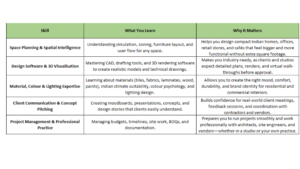
From semester one, you elevate from sketches to professional 2D drawings and 3D models with tools like CAD and 3D rendering software. Having these skills makes you job-ready to work within studios and companies across India, as clients now expect realistic renders, walkthroughs, and detailed technical drawings to approve any project.
2. Space Planning & Spatial Intelligence
The Interior Design Program helps you read spaces thoroughly, and the spatial planning muscle enables you to design compact Indian apartments, retail stores, offices, and cafes that feel larger, smoother, and more usable without requiring extra square footage.
3. Material, Colour & Lighting Sense
You get a strong understanding of materials (tiles, laminates, fabrics, wood, glass, metal, paints) and how they work in Indian climates, budgets, and important usages. And you also learn the principles of colour theory and the processes of lighting design, so you have control over mood, comfort and brand identity in the homes and commercial interior spaces.
4. Client Communication & Concept Pitching
An interior design program trains you to take your ideas and develop them into a clear presentation, moodboards, and a thought process that the client can understand and trust. You practice presenting your rationale, taking feedback, and dealing with criticism, just like you will with real clients, contractors, and vendors after you graduate.
5. Project Management & Professional Practice
You don’t just design; you learn how to manage timelines, costs, coordination on site, and basic documentation. The creative and managerial skill set allows you to develop confidence in your ability to work alongside architects, site engineers, and vendors in a studio or when starting your own practice in India.
Final Word
A career in interior design begins with establishing the right foundation first, and a well-recognized B.Des Interior Design program establishes this foundation for you. Whether it’s comprehension of spatial design, material application, digital tools, awareness of human behaviour, or practical project-related skills, these five core learnings prepare you to create functional, aesthetically pleasing, and future-ready spaces.
By choosing a top college in India or the best interior designing colleges in India, these programs source faculty expertise, studio-based learning, live projects, and experiential learning that shape your knowledge and skills, allowing you to translate your creative thinking into a productive career in design.
To summarise, interior design is much more than aesthetics and decorative environments — it is creating experience, and these five core learnings will shape you into a confident and employable interior designer rather than a novice.
FAQs
1. What are the core learnings in a B.Des Interior Design program in India?
B.Des in Interior Design teaches students 5 Key Areas of Knowledge:
- Using design Software, 3D Visualizations
- Space Planning & Spatial Intelligence
- Material, Colour & Lighting Design
- Concept Development & Client Communication
- Project Management & Professional Practice
2. Why is learning 3D visualization important for interior design students?
3D Visualization is important as today’s clients require realistic renders, walkthroughs & technical drawings before approving designs. Mastery of software such as AutoCAD, SketchUp, Revit & 3ds Max enables students to create professional representations of concepts, thereby improving employment opportunities in the studio, architecture firms & design agencies.
3. What is spatial intelligence, and why does it matter in interior design?
Spatial Intelligence refers to the capacity to read, plan & enhance any space. Spatial Intelligence enables Interior Designers to:
- better facilitate movement and circulation
- make the most of small Indian homes without adding square footage
- create better function in offices, cafés & retail spaces
- create a feeling of greater openness and orderliness
Spatial Intelligence is one of the top in-demand skillsets by employers and clients alike.
4. How does a B.Des Interior Design program teach material and lighting knowledge?
Students learn about:
- Properties of materials such as wood, laminate, tile, fabric, glass, metal, and paint.
- How materials act in the climates found in India, and the budgets for materials in India.
- How to use colour theory to give a room a certain mood or feel, or how to develop a brand identity through colour.
- Techniques of lighting both functionally and decoratively.
5. Does an interior design program train students to work with real clients?
Yes, students learn to create presentations, mood boards, concept designs and pitches. Students practice:
- Communicating with clients about the project they are working on.
- Presenting the rationale behind their design.
- Handling feedback and making revisions to their design.
- Translating the client’s requirements into a workable design solution.
6. Do interior design programs include project management skills?
Yes, it does. In this program, students learn about:
- Site Coordination
- Vendor and Contractor Management
- Budget and Timeline Management
- Documentation and Bill of Quantities
- Material Information and Sourcing
- Execution Planning and Process Improvements
This helps them work confidently in studios or run their own practice.
7. Is interior design only about aesthetics?
No, Interior design is not just decoration. It combines technical drawing, space planning, ergonomics, materials, sustainability, user psychology, and software skills to create functional, human-centred spaces. A good designer solves problems, not just beautifies spaces.
8. What career options are available after a B.Des in Interior Design?
- Interior Designer
- Space Planner
- 3D Visualiser
- Furniture Designer
- Material Consultant
- Design Researcher
- Lighting Designer
- Interior Stylist
- Freelance Designer
- Design Entrepreneur
Many of these careers may be found in Architecture Firms, Design Studios, Real Estate Companies, Corporate Offices, or Independent Design Practices.
9. Which colleges offer the best B.Des Interior Design programs in India?
Some of the best Colleges for Interior Design in India include:
- NID
- The Design Village (TDV)
- Pearl Academy
- MIT Institute of Design
- UID
- SID Pune
- CEPT University
These Colleges base their Education Programs on Learning through the use of ‘Studios’, Live Projects from the Industry, ‘Design Research’, and their Mastery of Software Skills.
10. What is the eligibility for B.Des Interior Design after 12th?
Most Design Colleges require:
- Completion of 12th Grade (any Stream)
- Entrance Examination Score (NID DAT, TDV Entrance Test, UCEED or School-Specific)
- Portfolio Review
- Counselling/Interview Round


